Hello friends,
Here I am popping back up again–I wrote this post last week in late January 2026 and an publishing it now in early February.
In January, like many people, I tend to think a lot about what changes I’d like to make in my life, due of course to our totally-unconnected-to nature Gregorian calendar and also to my work schedule, which runs in semesters. (Side note: I went down a bit of a rabbit hole reading about the Gregorian calendar. Our system of establishing days and holidays is complicated and political!)
Anyhoo, this year I am trying to focus on integrating parts of my life that feel segmented from each other. I am not sure even how to describe that, except that for many years I juggled being a part-time-working-primary-parent who was also trying to be a writer, and I think I succeeded in that (to the extent that I did “succeed,” whatever that means) by puzzle-piecing it all together. Here I would write, here I would work, here at 3:15 everything stops: it’s time for school pick-up.
But now! Now, my kid can drive, and my life is different. Add that to my reduced teaching schedule this semester (thanks, increased class sizes due to budget cuts!), and I find myself with a life and scheduling possibilities my clutching-a-newborn self could only dream of. (Apparently, I am into hyphenating today. And parentheticals.)
Yet, no matter what I am doing, I often have the haunting feeling that I should be doing something else. If I’m planning for teaching, I feel like I should be writing. If I’m writing, I think I should be grading. If I’m playing Goods Swap on my phone, I think I should be doing literally anything else. No activity seems meaningful enough, especially as democracy literally collapses in front of our eyes, not unlike this Sicilian town in the wake of a cyclone.
Yet, calm and intelligent voices in our society know the way. My friend Sydney, for example, has been gently guiding and gathering a community of like-minded people for over a year. A few weeks ago, I broke through my tendency for solitariness and joined them, where I got to hang out with wonderful people, and where one of those wonderful people introduced me to this amazing writer Devon Price. Not only has Devon Price written a book called Unlearning Shame that I most certainly could have used while I was writing White Lung, he wrote this post on his own blog about how frozen many people are feeling right now:
That quote reminds me of a Venn diagram related to the book What If We Get It Right, where readers who want to combat climate disaster but are too paralyzed to take action are encouraged to find places where things you care about, things you’re good at, and things that need to be done overlap. Check it out and ponder here.
One part of my life I’d like to spend more attention on is this blog, but of course, since I’m an overthinker (gasp–having some breakthroughs over here after five years of therapy), pondering that made me think about what, really, is the purpose of this blog. I enjoy writing it, and I think I’m reasonably good at it, but is it doing anything that needs to be done? Blogs, historically and obviously, are “a platform where individuals share their personal thoughts, opinions, experiences, and activities, resembling an online diary” (EBSCO). My blogging days actually began with a kind of a mommy blog I retired several years ago, which was for sure an online diary about early motherhood. When I started this author website, I thought I’d use the blog to write about poetry, which I have done.
But now! Now, we find ourselves in a real moment, a moment in which… how to put it? A shit-is-hitting-the-far moment. A the-shit-has-hit-the-fan-and-we’re-getting-sprayed-with-shit moment. What kind of online diary-weblog do I want to write?
I had the idea of this blog being a place to process what’s happening. Mainly, it’s a place for ME to process what’s happening, since I am the writer, and it seems (again, thanks therapy!) that I process through writing. But also–I think that as Americans, we don’t really process stuff super well.
Let’s take a moment to process just that last sentence. I mean, first of all, we’re a country with a history of first, extreme racial oppression, and then, extreme institutionalized racism, and we tend to deny or, at best, ignore that history. We certainly haven’t processed it. To “process” something can mean a number of things: to talk about it, to reflect on how it made you feel, to consider how it fits into your larger narrative, to accept it, to integrate into your big picture. And of course, the process of processing begins with acknowledging that something happened.
I could write so much more about that example, and probably will in the future, but for now, I want to acknowledge something else: that some of the best people I know right now are feeling even more frozen, uncertain, and powerless than they did even last year at this time, and than they did in, say, just to randomly throw out a year, 2016. I think that is interesting. I think that says something about our culture, that we are ten years from that moment, and we’re still as shocked and confused and frozen as we ever were.
I don’t think it’s surprising, though, because our culture–our capitalist, patriarchal, puritanical, hypocritical, and white-supremist culture–tells us to keep going at all costs: to keep working, keep spending money, keep improving. We spend the season of the winter solstice, which if we followed nature would be the calmest, quietest, most hibernatory season of the year, spending even more money than usual and doing exhausting stuff, in the name of a religion some of us don’t even belong to, and most of us who do belong to don’t actually follow in spirit. So we don’t take time to process. Add in the insanely frenetic pace of the news cycle, and how much we have to work to pay the bills and keep food on the table, and the lack of our society’s ability to address broken systems like child care, health care, elder care, etc, our brains are too fried to process anything anyway. We keep going. We look at our phones, and we keep going.
That said, we are good people. Anne Frank said it about her culture, and I agree with her: I think most people are good at heart, and will help each other if given the chance. My mother mentioned this in the wake of Hurricane Helene in her part of the county, that neighbors and strangers alike came together to help each other the best they could in a time where they had lost the most. You commonly here this sort of the thing in the wake of crisis: people help each other. It’s happening in Minneapolis now (though this article points out this moment there has an important foundation we should all try to be building in our own cities). Mostly, it’s within the chronic, mid-grade traumas of dailiness that we freeze, or melt, or become paralyzed.
So, I thought, maybe my blog could be a place to process, for myself and for my readers. At least, the very least, I could try to keep a record of what’s happening, for my own memory and for the collective’s. It could be a start on my one thing, my lane of resistance. My idea is to write weekly-ish, though that might end up being monthly-ish. My goal is to start with another post soon with a kind of recap or roundup of the past year.
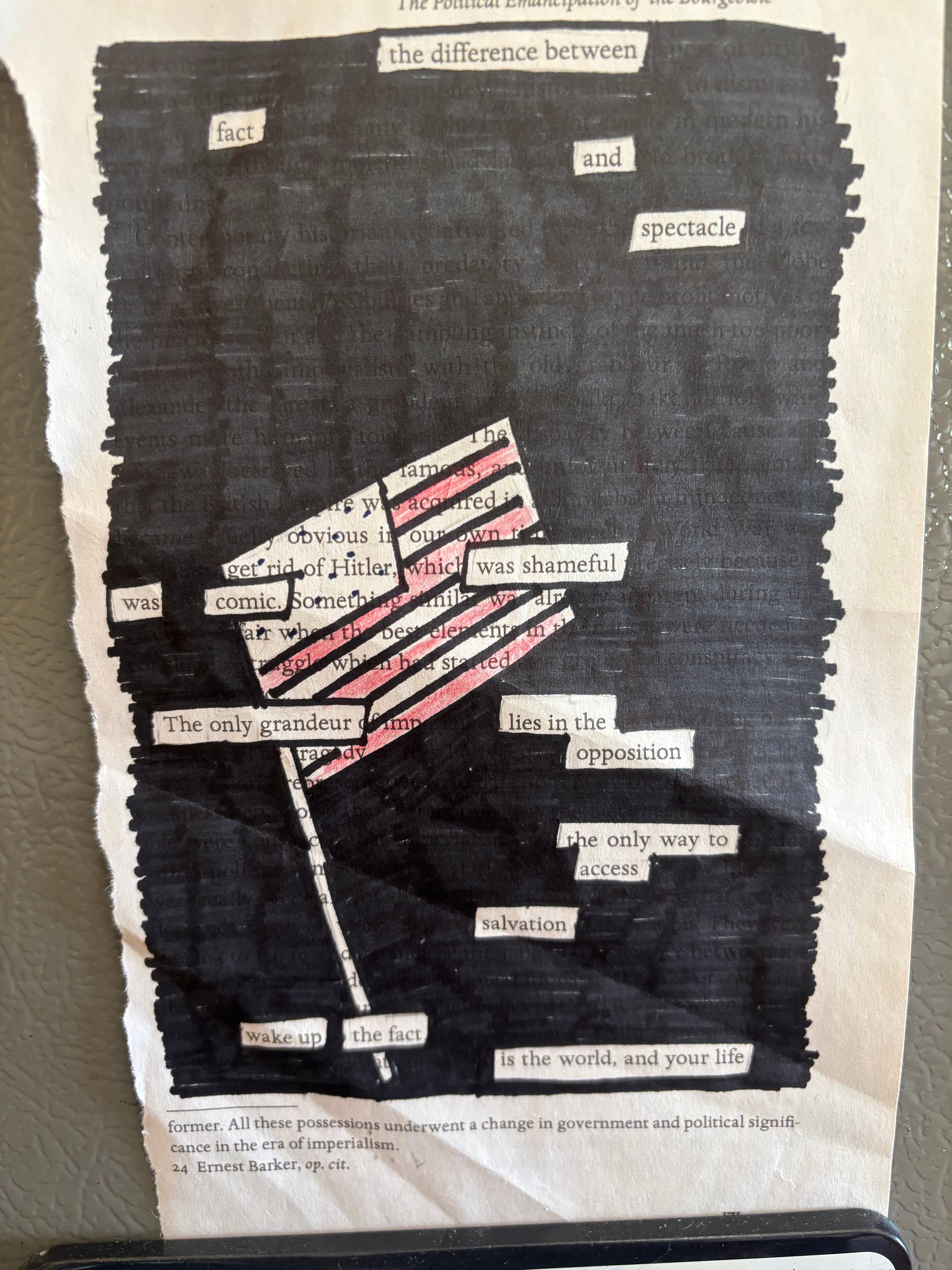
So, stay tuned! Before I sign off, let me invite you to comment on this post or share it with someone else if you think they might like it. I spent the better part of an afternoon writing it, all the while haunted by the sense that I should be grading or writing a poem or walking the dog, or even doing this other project that I’ll sign off with below: turning Hannah Arendt’s The Origins of Totalitarianism into blackout poems–because why not?
Enjoy, and love till next time!


Leave a comment