Hello, friends,
I’ve been pondering this post for a long time. Several times lately I’ve mentioned to friends that I am trying to write it. They, kindly, ask what it’s about, and my mind goes completely blank. Oh… I don’t know, I say, floundering. About living in these dark days, I guess.
Perhaps I can get at what I want to say with a few false starts, separated, poetically, by stars, thus leaving the reader to make their own connections???
Let’s try it.
***
When I teach college composition, I teach a concept called stasis theory. Stasis theory is a framework for thinking about arguments–not what an argument is about, as in the topic (eg: voting rights, climate change, abortion) but what type of argument it is. There are various explanations of stasis theory out there, but the model I was taught, and that I teach, is this:
| Stasis | Questions |
| Existence / Definition | Did X happen? Does X exist?What is X? How is X defined? Examples: What is a factory farm? What is life like for animals on factory farms? |
| Cause/Effect | What causes X to happen?What are the effects of X? Examples: What is the impact of social media on teenagers’ mental health? What causes farmers to maintain a factory farm? What effects do factory farms have on the environment? |
| Value | Is X…Good or bad? Right or wrong?Better or worse than alternatives to X?Should X be sought or avoided? Examples: Are electric cars helping or harming the environment? Are factory farms better or worse that family farms? |
| Action | What should we do about X?What actions are possible?What proposals should we make about X? Examples: How should college students use LLMs in their coursework? Should we regulate factory farms? |
| Jurisdiction | Who should handle the matter of X?Who has the right to make decisions about X? Examples: Who should make rules and decisions about AI use in education? Who should decide if trans teens get gender affirming care: parents, or the government? |
Stasis theory is helpful is stepping back from the heat of an argument’s content to think about where the disagreement lies. It’s also helpful in inspiring new and interesting research questions, which is mostly how I use it in my teaching.
I’ve been thinking a lot about “existence.” It seems to me that what I am tempted to call “these dark days” is a time of constant astonishment at the level of existence . The press has been kicked out of the White House? The president said what? AI’s gone rogue? The president posted what? We’re at war, still?
Etc.
***
Recently, Greater Good published an article called In the Face of Crisis, Psychologists Urge a Return to the Basics, by Katherine Reynolds Lewis. What are the basics? Human connection, tactile hobbies, and going to pubs.
***
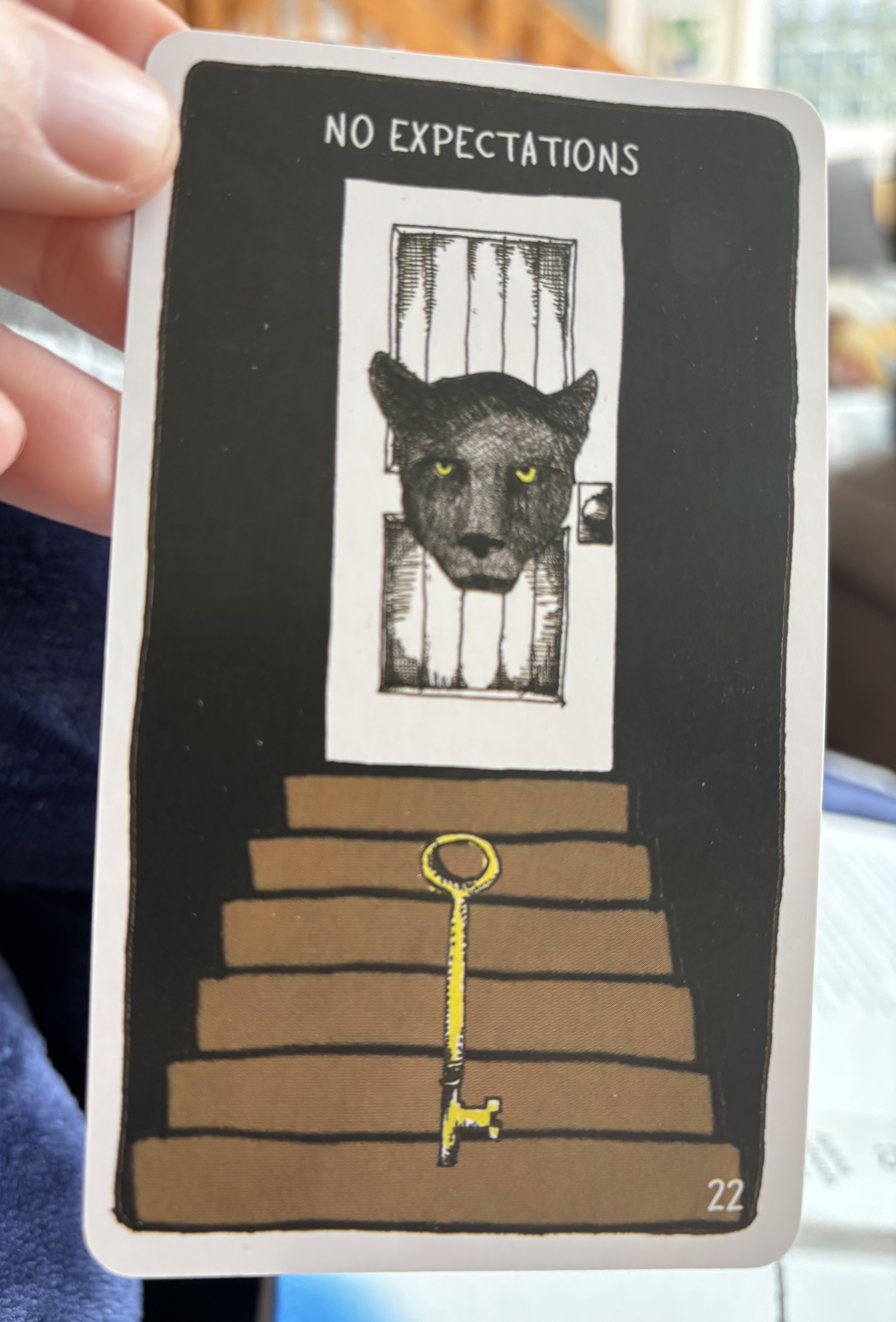
This morning I pulled this card from my new favorite oracle deck, Animal Apothecary:
No Expectations.
It’s a black panther staring from a closed door above a stairway. Along the stairway is a key. The guidebook elaborates: “A situation you perceive as a failure today may be what leaves you to unfathomable success in three years. This is why an expectation of how you think things should work is futile.”
***
Last summer and fall, I faced what has been so far, and what I surely hope remains, the worst period of my life. At what point, my therapist asked me how I thought what I’d been though might shift my life purpose. I just want to be happy, I said, and for the people I love be happy. The purpose of life is to be happy.
***
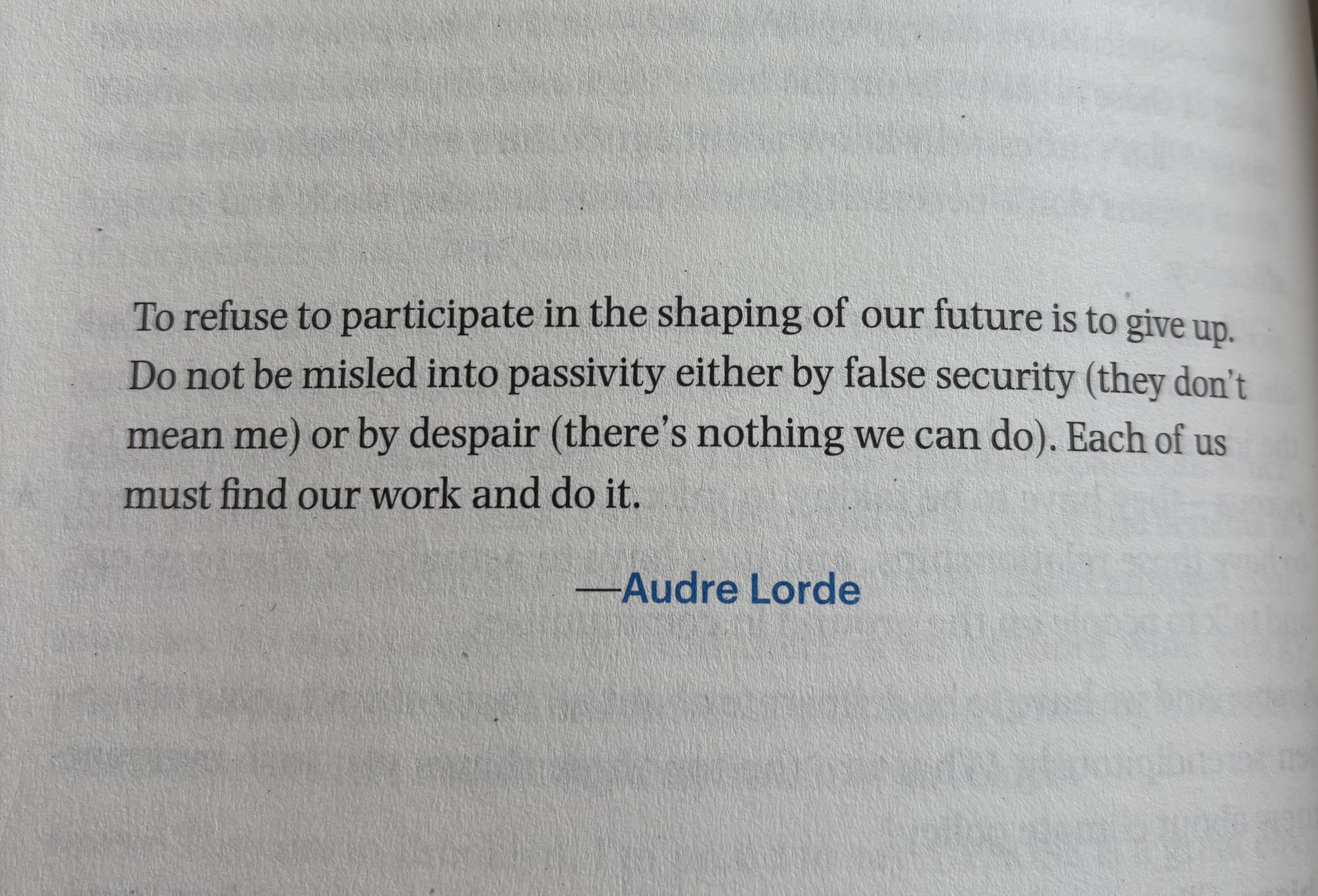
I remember that several years ago, I bought a book called What If We Get It Right: Visions of Climate Futures. I wander to my bookshelf, spot it immediately, and open it randomly to these words from Audre Lorde:
***
Bonus link from Greater Good! Seven Ways to Outlast Political Authoritarianism
***
In all the best revolution stories, there’s always a secret gang of unassuming people doing the small, ongoing tasks of preparation for what’s to come, for what they see coming. So when the hero’s moment arrives, it rests on decades–maybe longer–of steady, quiet, groundwork.
What gets in the way of steady, quiet groundwork?
Panic, despair, overwhelm, guilt.
What does it take to do steady, quiet groundwork?
Nourishment, connection, boundaries, rest.
***
That’s all I’ve got for now. Love to all you humans out there reading this!


Leave a comment